In Lisbon during the St. Anthony festival, partygoers ride giant sardines to the land of cheap beer.
Every June, Portugal parties with a vengeance in the name of God. Because June is the feast day month for three prominent saints of the Catholic Church: Anthony of Padua, John the Baptist, and Peter the Apostle (Simon Peter). Lisbon, especially, goes all out for St. Anthony, their hometown guy, who was born in the city in 1195. Though his feast day is June 13, Lisbon sets aside both the 12th and 13th for celebrations. Officially, at least. In truth, from what I learned while visiting the city from June 3-12, the party for St. Anthony starts winding up the minute May turns the summer fun over to June.
St. Anthony dedication made of wristwatch bands in Lisbon shop window.
Family decorating front of their house for St. Anthony festival.
So how does Lisbon celebrate a saint? Must be pretty dull and pious, this party, like with ashes and lots of kneeling and eyes tearing up with all the Catholic guilt and incense flying around. Yeah, not quite. Instead, it's more like parades and fado music and sardines on the grill and shots of cherry liquor and cups of sangria drunk in the street, and pots of basil and marriage matches and colorful streamers making zig zag lightning bolts from rooftop to rooftop and window to window over the narrow cobblestone lanes of Lisbon's beautiful smelly old up-and-down Alfama and Mouraria neighborhoods.
Street party setting up in Alfama neighborhood for St. Anthony fest.
Laneway in the Alfama.
Statue of St. Anthony with his church in background.
Church dedicated to St. Anthony in Lisbon -- the church was built on the site where he was born.
Tiny altar in a basement room of St. Anthony's church in Lisbon, marking the room where he was born.
When I first decided on going to Portugal and booked my flight dates, I didn't know about the St. Anthony festival, or I might have made sure to book my return date for the 14th so I wouldn't miss the two biggest festival days. While I did miss the parades and mass weddings and marches, the good news is I still got a taste of all the pagan-tinted saintly fun. I arrived to find parts of Lisbon, including Alfama, the neighborhood I was staying in, getting decked out, setting up party booths and tables in the streets, grilling sardines, stacking their steps and windowsills with little shrines and altars dedicated to St. Anthony, loading up on the basil and ginja -- in general, having fun, getting down, living the life.
Grilling sardines and selling ginjinha (cherry liquor) in Alfama.
Grilled sardines with potatoes, peppers, and "salad."
Pots of basil for sale, with love notes for potential mates. Lisbon men give basil as tokens of affection to their love interests during the St. Anthony celebrations.
Having been raised Catholic, even if the festival for St. Anthony wasn't previously known to me, Anthony was. For St. Anthony is the patron saint of all things lost -- objects, people, souls, limbs, dreams. Misplace your keys? Pray to St. Anthony, he'll help you recover them. GPS let you down and left you driving around in circles? Send the address you're looking for up to St. Anthony, he'll show you the way. Losing heart, losing hope? Maybe St. Anthony can help recover that sort of thing too, restore your faith in humanity, lead you back to your belief there's something better or more to life than just going along blandly, forever and endlessly and desperately trying to match up keys to houses and owners and cars or addresses to red and blue targets on a Google or GPS map or dreams and aspirations to everyday challenges and average Joe/Jane circumstances. If not, there's always Lisbon in June to distract you from your lingering life doubts.
Statue of St. Anthony and wall of flowers by his church.
Altar to St. Anthony set up outside his church.
Beautiful giant wall of flowers beside St. Anthony's church.
Are you looking for grilled sardines?
Yes, we have sardines.
As do we.
We not only have sardines, we have Shakira and Sly Stallone at our party.
Another St. Anthony altar.
And another!
And another!
This ones comes with a lifesize Anthony.
This one has a name, Lucinda, the object of the altarmaker's affection. They will be getting married on the 12th, during the mass marriage ceremonies across the city.
This altar features Anthony, Our Lady of Fatima, and booze.
Bleachers set up on the Avenida da Liberdade for the big parades on the 12/13th.
Celebrating a few days ahead of the feast day in Mouraria.
This is just outside one of the fado clubs in the Mouraria -- everyone was singing, eating, drinking...
Keep the sardines coming. In the Alfama.
Pots of basil, pots of love for sale in the Mouraria.
Window altars in the Alcantara neighborhood.
Getting ready in the Alcantara.
St. Anthony altar made of stones, by the riverside in Lisbon.
Stumble down fun in the Alfama.
Sardines and silhouettes on the wall in the Alfama.
St. Anthony watching from a window.
Ginja, chocolates, sangria, "wisky," vodka, red bull -- St. Anthony, please help me find my sobriety!
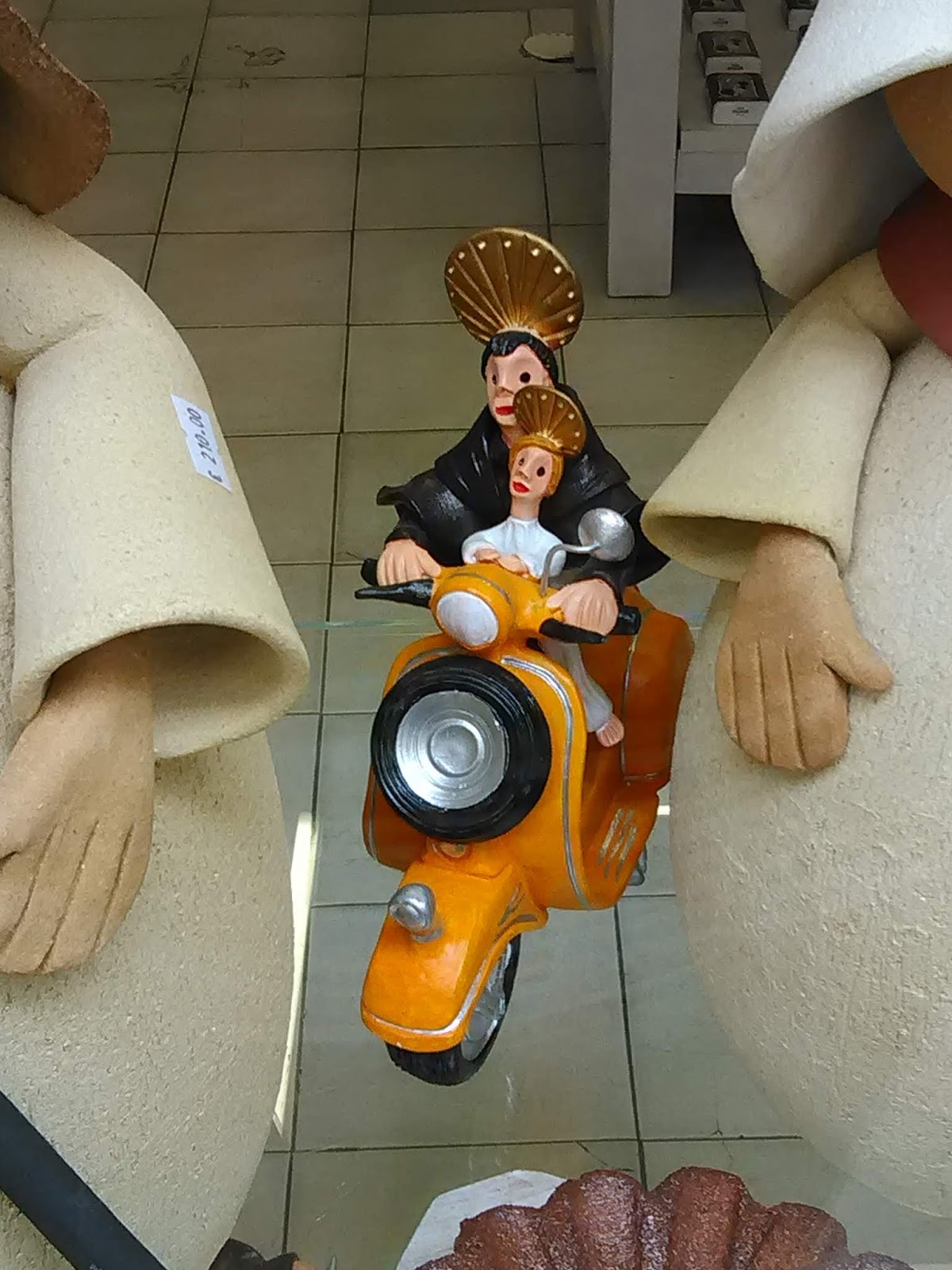
St. Anthony taking young Jesus out for a spin. When you see this on the streets of Lisbon, you know you need to scale back on the ginja.
Today is the feast day of the Virgin of Guadalupe, the patron saint of Mexico. Actually, the patron saint of the U.S. and all the Americas. For this day, I'm sharing this pic of a little shrine to the Virgin in Cuernavaca, Mexico. This shrine was set up in a little nook or square cutaway in the wall surrounding the city's cathedral. It was in the part of the wall near the entrance to the Church of the Third Order of St. Francis.
There are at least three images of the Virgin in this shrine: the statue of her on the right, the picture of her hanging on the back, and a small image of her on the front of the vase holding the flowers on the left. If I'd pulled back the camera a bit when I took this pic (in 2010), there would probably be one or two more images of her visible, perhaps on the votive candle holders seen at the bottom of the photo.
The image of the Virgin of Guadalupe is all over the place in Mexico--in homes, in churches, in shops and restaurants, in parks, in the zocalos or plazas that form the center of Mexican cities and towns, in jewelry, on people's bodies, in graffiti, on tee-shirts and skirts and dresses, in people's hearts, in the history books and mythologies of Mexico and the Mexican people. The story goes that the Virgin first appeared to a peasant indigenous man named Juan Diego on December 9th, 1531, on a hill near modern-day Mexico City. She appeared to him 4 times over the next few days, asking him to have a church built in her honor on the site where she appeared. When Juan Diego took her message to the archbishop, he was asked for proof of the Virgin's appearance. So the Virgin healed Juan Diego's uncle and told him to gather Spanish roses from the hilltop where he saw her, even though it was December and Spanish roses didn't grow at the site any time of year. Juan Diego collected the roses in his tilma (a cloak made of rough fabric such as cactus fibers) and took them to the bishop. When he opened his tilma to show the roses, they fell to the floor and an image of the Virgin was visible on the inside of his cloak. The image of the Virgin on the tilma remains visible today, which can be seen at the Basilica of Our Lady of Guadalupe in Mexico City.
Apart from its miraculous origins, the image of the Virgin of Guadalupe is striking and significant for the ways her physical appearance differs from depictions of European madonnas. The Virgin of Guadalupe is darker-skinned and wears a mantle of turquoise blue--turquoise being a stone and color native to the Americas and well known to the Aztecs--rather than the traditional Marian blue of European art. Underneath the Virgin and the crescent moon she is standing upon, an angel with eagle's wings holds up her the train of her dress--the eagle being another native species to the Americas, a powerfully symbolic bird to the Aztecs, and a reference to the indigenous name of Juan Diego (Cuauhtlatoatzin, "one who speaks like an eagle"). I'm a fan of the Virgin of Guadalupe. I don't know if the story of her and Juan Diego is true or just a clever conversion story, or if the imaged tilma in the Basilica is the real deal, but I like what Guadalupe represents. I like her style. Even here in the U.S., her image is rather common, especially in communities with large Mexican populations like Chicago. There's a painting by one of my favorite artists, Kelly Vivanco, that reminds me of the Virgin of Guadalupe, though I'm sure there's no relation between the subjects. I also have a friend who is a teacher at a public high school in Chicago, a school in a Latino neighborhood with a large number of Latino students, and she told me a revealing story about an image of the Virgin. Across from the high school is a house with a garage door that kept getting covered in graffiti by some of the students. Every time the door got tagged with graffiti, the owner of the house would paint over the graffiti. Soon as his paint dried, it never failed--the door would get bombed again. Finally, the man (who was Hispanic himself) thought to place a poster or portrait of the Virgin of Guadalupe on his garage door. The kids never tagged it again. This is a woman who commands respect. For English speakers who'd like to read more about the Virgin of Guadalupe, I recommend a book of stories and essays curated by Ana Castilo called Goddess of the Americas. It has some great pieces in there by Castilo, Sandra Cisneros, Richard Rodriguez, Octavio Paz, and many others (my favorite in the collection is Luis Rodriguez' "Forgive Me, Mother, For Ma Vida Loca"). The author Clarissa Pinkola Estes (of Women Who Run with the Wolves fame) also has a book about the Virgin called Untie the Strong Woman--the chapter called "Guadalupe Is a Girl Gang Leader in Heaven" is the best of the bunch.
Hi friends. Some new pieces of mine are up at a couple sites, so I'm sharing the news and links.
Today the latest issue of Literary Orphans went live. It's the Orphans' gang's 12th issue and it's themed around Ireland and Irish writers--with master satirist Jonathan Swift serving as the issue's granddaddy and inspiration, and master storyteller James Claffey serving as the issue's guest editor (taking over the role from LO's ed-in-chief, Mike Joyce). Here's a link to Claffey's editor's note with his thoughts on the issue and how the pieces in it confront and challenge Ireland's long literary history and Irish writing's more tried and tired themes.
There's a piece of mine in this issue. It's called "All Apocalypses, Bitter and Sweet." It's about a few things. An Irish saint named Gobnait, for one. Also bees, women, broken hearts, apocalypses, the Aran Islands, and the search for resurrection. Given that today is Easter, the ultimate day of resurrection in the West, maybe you'll find my story a good fit for Easter reading. In any case, I hope you give it a read and hope you enjoy it too.
Cill Ghobnait on Inis Oirr, looking towards mainland
Altar of Cill Ghobnait, Inis Oirr
Humble Cill Ghobnait with grave in foreground
I should say that this particular publication is a pretty big deal to me. Literary Orphans is a fine and fearless literary project--and homegrown in my hometown of Chicago to boot. As well, I recognize a few of the names attached to this issue--there are some true rising-star writers here and it's an honor to be featured in an issue alongside them. I hope you give all the pieces in this issue a read. And thanks again to James Claffey, Mike Joyce, and Scott Waldyn (managing editor at Literary Orphans) for accepting my piece and for all the hard work they put into this issue.
Today is All Souls Day. In the traditional calendar of the Catholic Church, this is the day set aside to remember and pray for the dead. In the U.S., we don't hear much about this day. As soon as midnight strikes on Halloween night, we forget celebrations of all things ghostly and ghoulish, without a moment's thought for our dearly departed, and turn our minds immediately to the next big American holiday--Thanksgiving. The contrast between the two celebrations of All Souls Day and Thanksgiving is striking and reveals a lot about the cultures that celebrate one over the other. If Thanksgiving is about giving thanks and praise for what you've got, All Souls Day is about giving thanks and praise for what you've lost. It's the difference between reflecting on what you have versus reflecting on what you've had that is now gone.
Grave of John Kinzie, first permanent settler of European descent in Chicago
Egyptian-inspired mausoleum of railroad magnate Darius Miller in Rosehill Cemtery in Chicago
Celtic cross marking burial site of A.C. McClurg, Civil War general and original publisher of the first Tarzan books
Americans don't like to dwell too much on death and loss. Our culture is a youth-worshipping one that puts the focus on what you can acquire, gain, and win in life, the pursuit of happiness or riches or power or, to be fair to many of my countrypeople, maybe just a decent roof over your head, a good education, a satisfying job, and three squares a day. In any case, it's a culture that doesn't like to think about what's missing and can never be had again.
In other cultures, it's just the opposite. In countries like Spain, Mexico, Haiti, Ireland, and many more with a strong Catholic history, the first days of November are given over to honoring those who came before us, all our departed friends and family and ancestors. Some of these countries celebrate with parties and fiestas, special masses, and visits to the local cemeteries to decorate or leave mementos at the graves. Depending upon the culture, it can be a surprisingly upbeat and colorful celebration or a more somber one. Either way, it's just a way to acknowledge and pay respect to the most inevitable fact of life--the end of it.
Cemetery in Galicia in Spain, few days after All Souls Day
This year I planned to visit one of Chicago's most famous (and haunted) cemeteries on Halloween, snap a few pictures, write a post about it. Well, I didn't make it to the graveyard that day--and maybe it's for the best, since visiting a cemetery on Halloween is not exactly a very original idea. Valhalla knows how many other people I would've encountered there. Not to mention that the cemetery I'd planned on visiting--Graceland Cemetery, on Chicago's north side--usually has a few organized tours of the graveyard going for Halloween.
So I waited until today, All Souls Day, a quieter day since it's mainly a forgotten day in the American calendar. I went to Graceland and my parents came with me. None of us are new to Graceland Cemetery. My father's grandparents are buried there in fact, in graves with flat, almost sinking headstones in a far back corner of the vast cemetery grounds. They aren't next to each other for some reason, the graves of my great-grandfather Karl Ostberg and great-grandmother Anna Ostberg. And Karl's is backed up against a wall, above which the city's Red Line el train rumbles by all day and well into the night.
My great-grandfather Karl's grave in Graceland Cemetery, Chicago
Scraping fall leaves of Anna's grave in Graceland
My parents looking for Karl and Anna's graves, el train passing by above
The very humble graves of my great-grandparents (who immigrated to America from Norway) make a striking contrast to much of the rest of the graves in Graceland. Because along with poor, immigrant nobodies like my kin, Graceland is the resting site to industry and architecture bigwigs such as Marshall Field, Henry Harrison Getty, Potter Palmer, Louis Sullivan, and Daniel Burnham--to name just a few. The graves of these gentlemen and other powerhouses like them are both mighty and intricate in design--in a city known for its pioneering architecture, many of the graves and tombs at Graceland are architectural wonders in themselves. Thus, Halloween is not the only day when people gather for walking tours of this place, and my own family's familiarity with the cemetery extends beyond the forgotten corner where my great-grandparents lie.
I think there are two kinds of parents in this world: the kind of parents who take their kids to visit dead people for fun and the kind of parents who don't. Happily, I was raised by the former variety. Growing up (and to this day) I never did things like snorkeling or water skiing, and rarely did my family even visit amusement parks. Instead our family vacation activities have involved tracking down an old Irish immigrant ancestor's grave in unconsecrated ground in Iowa, the final resting places of Wild Bill Hickock and Calamity Jane in Deadwood, South Dakota, the monument to President Taft that no one bothers to even walk in the direction of in Arlington National Cemetery (where everyone is too busy paying their respects at the Kennedy gravesite, which, yes, we also visited), soldiers' graves at various Civil War battlefields throughout the former Union and Confederacy, dead poets' graves, dead pets' graves, Elvis's grave in that other Graceland, Abraham Lincoln's tomb in downstate Illinois, and the crumbling old headstones of long-gone patriots Paul Revere and Crispus Attucks. When we weren't grave hunting all over the USA, we were enjoying summer afternoons roaming around Graceland. I loved visiting Graceland Cemetery. Apart from the sense of pride that we actually had family buried at such a famous Chicago tourist attraction (which Graceland indeed is), my brothers and sisters and I liked to scare each other at the graveyard's spookier-looking tombs.
My sister Arla, me, and my brother Eric at the Pullman Memorial in Graceland, 1980s
My sister sitting on a headstone, Arlington National Cemetery, early 1970s
Havin' a good time in Graceland, Chicago, 1980s
Graceland Cemetery is a bit of a freaky place. When my dad was growing up (and going to nearby Lake View High School), he and other kids were able to climb over the cemetery walls in search of ghosts at night. These days, there's a barrier of barbed wire stretched all along the top of the wall to keep people from getting in after visiting hours. It keeps the riff-raff out, but only the living, human kind. Coyotes have been known to haunt Graceland (I saw one myself today--what kind of omen do you think it is to see a coyote in a graveyard on the day of the dead?), and of course ghosts.
The cheerful tomb of Ludwig Wolff
Wolff's tomb half-buried at Graceland Cemetery
Is that Ludwig Wolff's howling midnight guard...or just a city coyote?
Coyote (behind tree) in Graceland on All Souls Day
Two more canines, one headless, in Graceland
One of the creepiest graves is a tomb built partly underground that belongs to the very Grimm-ishly named Ludwig Wolff, a German coppersmith. Legend says a large, green-eyed wolf guards the tomb at night and has been heard howling during full moons. (Sure that wolf isn't just one of the Graceland coyotes, ghost hunters?) Competing with the Wolff tomb in creepiness is a statue at the other end of the cemetery of a tall, green, Grim Reaper-like figure, a sculpture called Eternal Silence by the artist Loredo Taft that marks the burial site of an early Chicago hotel owner named Dexter Graves. This statue is truly unsettling. It's a pity you can't go into the cemetery after dark to get the full freak-out experience of it. It used to be said that the statue was haunted in such a way that it couldn't be photographed or captured on film. Check the pics below to see how well that story holds up.
Statue at Dexter Graves's burial site--ghost in the reflection?
Me gettin' cozy with Death
I think the grave that affected me the most, that stayed in my thoughts for days after seeing it as a kid, was the one of a little girl named Inez Clarke who died at the age of 6 in 1880. Her grave is of a life-size marble statue of the girl, sitting with a little parasol inside a glass case. The glass case was prone to vandalism for a time--when I was young I remember seeing it broken by a bullet or BB hole. Why would someone shoot at the little girl in the glass box, I remember wondering when I was young. Was that how she died? In fact, it's not clear how Inez Clarke died--some say she died from tuberculosis, others say she was struck by lightning. It's said her statue sometimes goes missing from the case at night, especially during bad storms, only to be found in its proper place the next morning.
Statue of Inez Clarke, died age 6, at her grave
The little girl in the glass box
What she sees...when she's there
Apart from hauntings, many of Graceland's graves and tombs are quite imposing. Piano and organ man William Kimball's grave is a classical monument with giant columns and an angel--whose face is missing oddly enough, given the other details of the statue are largely still visible and unweathered. The grave of super-rich Potter Palmer, founder of the beautiful Palmer House hotel in downtown Chicago, one-ups Kimball's monument with a full classical-style temple with 16 Ionic columns and granite sarcophagi. Palmer's monument is located on the edge of a small lake in the cemetery that features a tiny island, reached by a wooden bridge, where the graves of Daniel Burnham and his family are found. Burnham is the man who essentially made Chicago into the stunning city it is today--an architect and urban planner who developed a plan for the city at the start of the 20th century that included an accessible lakefront (accessible to the city's people as a whole and not just privately available to the rich) and parklands and green space for every neighborhood. Burnham's island is a lovely spot, and a mecca for young architecture students and urban planners. Once while walking around the cemetery with my friend Shirese, we were coming back across the bridge from Burnham's island when we saw a car pull up and a young bride and groom, with their parents and a photographer, jump out of the car. The bride wore a white dress and sneakers, and she and her groom quickly crossed the bridge to get their picture taken at Burnham's grave. "Wow," my friend Shirese said once we were out of earshot of the little group. "Talk about 'til death do us part'."
Kimball Memorial in Graceland
Faceless angel at Kimball's grave
Potter Palmer's monument
View of Palmer monument from across lake in Graceland
Daniel Burnham's grave on an island on the lake in Graceland
The accessibility of Burnham's grave (and his vision of Chicago) stands in contrast to George Pullman's resting place. Pullman's monument looks like a stripped-down version of Kimball's, with no angels and only one column. But beneath this elegant memorial is Pullman's coffin covered in tar and asphalt, sunk in a giant concrete block, covered over with railroad ties and more concrete. His burial supposedly occurred at night under the protection of armed guards. Pullman was a pretty unpopular fellow. An industrialist who invented the railroad sleeping car (called the Pullman car), Pullman was notorious for mistreating his workers by demanding they live in his own company times at high rents with low pay that left them often penniless once their rents and food costs (bought at the company store) were deducted. His employees eventually went on a strike that pitted railroad workers against railroad magnates, the latter of whom were ultimately backed up by the federal government. Pullman died in 1897, only 3 years after the strike, and bitterness and hard feelings were still strong among his former employees (who'd all lost their jobs and were replaced by new workers forced to pledge not to join any union).
Pullman's memorial--more complicated than it looks
Private eye Allan Pinkerton's obelisk
Epitaph on Pinkerton's grave
Headstone of Timothy Webster, a Pinkerton detective
Memorial to Pinkerton employees, some of whom spied on Pullman's workers
Other impressive graves include those of former Chicago Daily News publisher Victor Lawson, whose site features another sculpture by Loredo Taft, this time of a crusading knight; and the world's first ever private detective Allan Pinkerton, whose obelisk grave bears a touching (if maybe a bit overdone) dedication that begins "A Friend To Honesty, A Foe To Crime." (It should be noted that while Pinkerton was responsible for heroic feats such as uncovering an early plot to assassinate Abraham Lincoln, his detectives also became hated for working as spies later on for the likes of George Pullman against union workers and organizers.) Meanwhile one tomb in the cemetery, known as the Getty Tomb, which houses the bodies of lumber magnate Henry Harrison Getty and his wife, has been designated a city landmark. A big cube of a tomb with delicate ornamentation, it was designed by the great architect Louis Sullivan--who also rests in Graceland, originally (and ironically) in a poor man's grave. Despite his genius (and his later tremendous influence), Sullivan died penniless. Today his original grave is flanked by a still modest but much more fitting monument that, like Burnham's grave, attracts devoted architects, artists, designers, and urban planners, who leave coins on the headstone to show their appreciation for his pioneering work.
Loredo Taft's Crusader marking newspaper publisher Victor Lawson's grave
Crusader for the truth
The Getty Tomb, designed by Louis Sullivan
Louis Sullivan's pauper's grave
Monument built for Sullivan 5 years after his death
Tribute to the great architect
Coins left for Louis Sullivan; the design on the side of the monument is meant to evoke the skyscrapers common to Sullivan's 20th-century urban vision
Just as modest is the grave of Ludwig Mies van der Rohe, another important architect whose grave--a plain slab of black granite--can easily be passed by unnoticed. The great boxer Jack Johnson, the first black fighter to win the heavyweight world championship, also lies beneath a simple headstone that doesn't even reveal his first name or birth and death dates. The only way a visitor can tell its Johnson's grave is by noticing the much smaller headstone of his first wife, Etta, whose marker reads "Beloved Wife Of Jack Johnson." Throughout his career, Jack Johnson was the target of intense racism, as were many of his fans who took pride in his achievements. Perhaps the most humble grave of anyone in Graceland with famous connections is...or was, that of English novelist Charles Dickens's younger brother Augustus. Augustus left England for America in the 1850s, abandoning a blind wife and arriving in Chicago with a pregnant girlfriend, the daughter of an Irish barrister. He had some success initially in various jobs, but he and his family were poverty-stricken by the time he died from tuberculosis in 1866. He was buried in a grave marked only with a small, flat round stone with a number on it--not even a name. That was his headstone, if you can even call it that, for over a century. Only in 2004 was a proper headstone erected bearing his name and those of his girlfriend and three of their children, paid for by his descendants and the Chicago Dickens Fellowship, a kind of Charles Dickens fan club.
Boxer Jack Johnson's monument with his wife Etta's headstone in foreground
Where Charles Dickens's brother lies
New headstone marking grave of Augustus Dickens, brother of Charles Dickens, The English Author
Augustus Dickens's spanking and spiffy new headstone got me thinking about the humble burial plots of my great-grandparents on the other side of the cemetery--up against the wall, disturbed by the rumble of the el all day, gradually sinking in the cemetery's soft earth. Perhaps I can get a Chicago Ostberg Fellowship going that can help fund nicer headstones for my ancestors? Why not? Dickens schmikens, I'm a writer too after all. Karl and Anna Ostberg, Great-Grandparents of René, The American Blogger...The Girl Traveler. I would indeed appreciate an appreciation club someday. Until then, I'm proud to have kin resting in such a beautiful graveyard, where my family hasn't forgotten them, All Souls Day or no All Souls Day. I think they even get more visitation than some of the bigwigs in Graceland do. Nobody leaves coins at their graves, but we put memories on paper and film, and I put these blog posts up, telling the stories of my amazing family.
Angel and sphinx marking tomb of a former beer baron
Pyramid tomb of the brewer
Honestly? This is the creepiest thing in the cemetery to me.
Headstones of German immigrants in Graceland
Headstone of the dancer Ruth Page, in Graceland
Poor Man's Grave?
That's another way of looking at death, I suppose. In Rosehill Cemetery, Chicago
Civil War soldiers' graves in Rosehill
Me at Ludwig Wolff's tomb, laughing at death but eyes shut with fear