Part 8 in an ongoing photographic study of a wayfarer in her natural habitat...here we see the wayfarer in Puerto Rico, juxtaposed with the wayfarer's spirit animal, the cat. ;-) This will probably be the last post on here for awhile, other than the occasional single-photo spotlight post or brief update (like if I ever get published anywhere again update) post.
Shadow at Pinones
Hiding outside the Old San Juan wall
View from a hammock, Casa Grande Mountain Retreat
Hammock selfie attempt--not as easy as you think it is
Prowler below the lookout, Old San Juan
Old San Juan
Strong sun and banana tree leaves, near Utuado
Leaves
Doppelganger. Felisa Rincón de Gautier, first female mayor of San Juan, near Paseo de la Princesa
Friend. Near the Felisa Rincón de Gautier museum, Old San Juan
There must be a word for the love you feel for the person you become when you're traveling. It's not narcissism or egoism and it's not mere self-care or self-preservation--the meanings of those words aren't the feeling I'm thinking of. Maybe the feeling and the appropriate word are something like actualization--that meaning combined with a sense of happiness and relief that a dream of yours is actually happening and here you are living it out and handling things quite well. Enjoying yourself, surprising yourself, looking out for yourself, being yourself--the self you've always known yourself to be beyond your work duties, parental or spouse duties, routine everyday settled-life duties. Because one of the great things about travel is that, while it never solves anyone's problems, it does tend to bring out the better qualities in a person--qualities like open-mindedness, creativity, adventurousness, self-reliance, gumption, patience. And from there (or here, or wherever the traveler happens to be) it can give a person a much-needed boost in self-confidence, give her back her faith in herself, and maybe some new or sharpened skills and strengths to re-approach her old problems.
Life goes in goes two directions. Rooftop in La Perla, Old San Juan
It's easy to get into a rut when not traveling, and easy to start feeling as if you've sold your soul to the gods of routine and making-a-living. Travel is one way that people jump-start themselves out of a rut--and even if it works for just a little while, for the few days or weeks or (oh you lucky duck) months you're on the road, well, sometimes that's all that's needed for a person to reclaim themselves, to re-acquaint themselves with the soul that got trampled in life's ruts before you decided to pick it up, dust it off, and run off down the road with it, right out of the ruts.
Calle Fortaleza in Old San Juan
Blind creation, in Da House Hotel, Old San Juan
In Plaza de Armas, Old San Juan
Calle Sol, Old San Juan
All of this brings me to a question that came to my mind while I was in Puerto Rico, specifically while I was in Old San Juan, the historic section of the capital city of PR. The question is: How do you travel?
It's not meant to be answered with a mode of transportation, like "by car" or "by plane, first-class and nothing else!" And it's not a question about whether you like to travel solo or with a group, with family, through an agent or on a budget or according to a guidebook's recommendations, etc. It's a question about how you bring yourself to a foreign place, your real soul self, and how you let that self bloom and grow while you're gone. How do you bring your soul to the places you travel to? How do you represent yourself as a person worthy of love and respect, your own and everyone else's, wherever you go in the world--and most especially how do you accomplish this in places where your soul is most vulnerable, when you're away from home?
I don't know why this question came to me while I was in Puerto Rico. Maybe it came to me because I kind of fell in love with the place. I enjoyed every day I was in Puerto Rico. The weather was warm, even in the mountains when it rained. The sun shone a good part of the time. The food, coffee, and mojitos were delicious. The people I met, down to the locals who gave me directions, the taxi drivers, and all the customer service folks I encountered, were all friendly and nice. I never felt unsafe at any point I was there--and that's a crucial factor for any woman traveler. I never felt unwelcome either, like I didn't belong, at any time--and that's a crucial factor for me.
Pigeons in the wall at Parque de las Palomas
Gato on the city wall by Plazuela La Rogativa
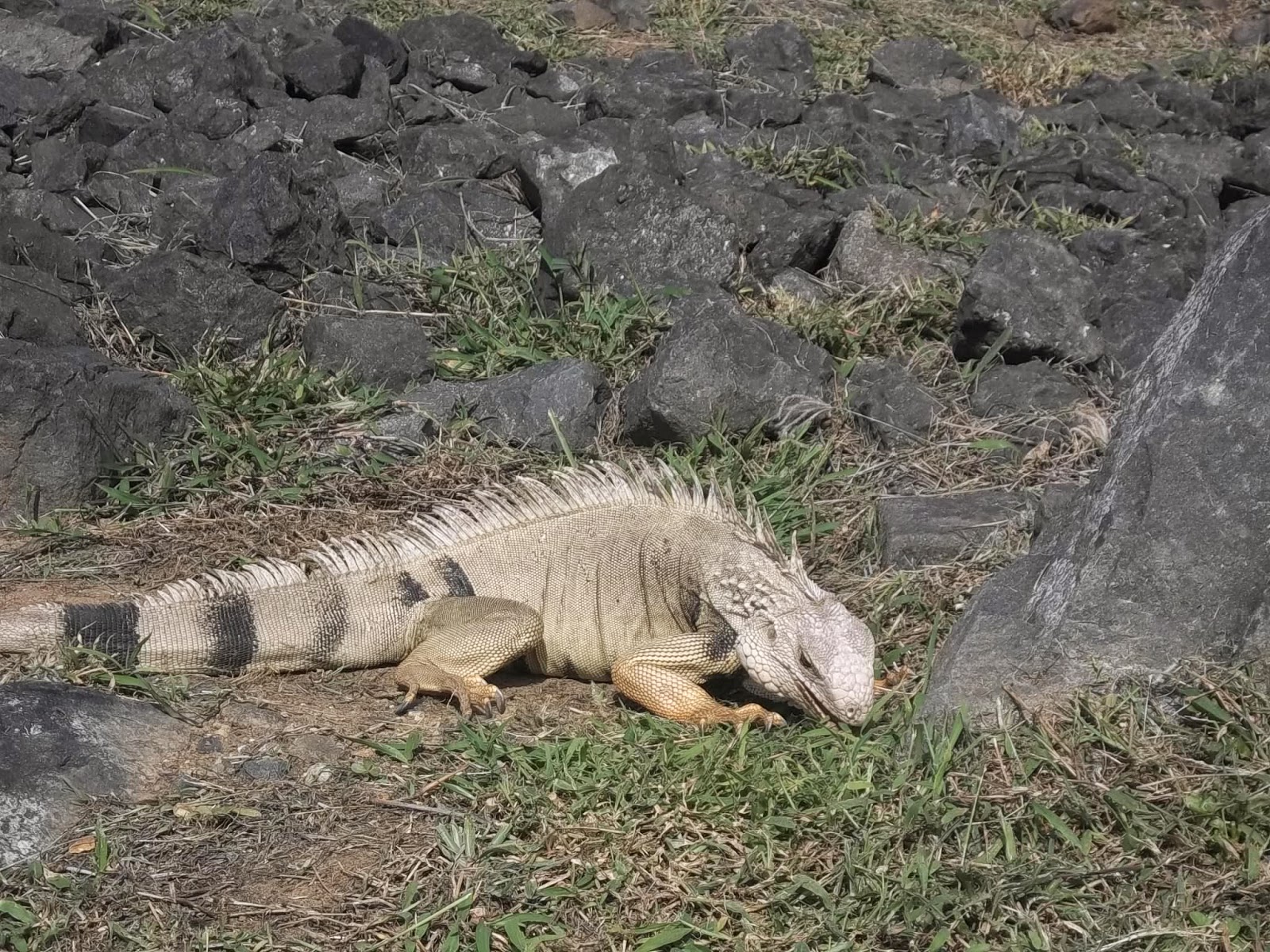
Iguana alongside path outside Old San Juan wall
The iguana sat up to watch a cruise ship passing by, Old San Juan
Belonging matters to me when I travel because I travel alone. What I mean by belonging here is feeling accepted and respected by others regardless of where I come from
in the world and how different I may appear in a new or other place. Feeling welcome, essentially. Traveling alone can make a person feel adventurous but it also very often makes a person feel awkward at times. Sometimes you get ignored or slower and poorer service in restaurants while dining alone and sometimes after signing up for an excursion or tour you find yourself the only person in the group on your own amongst a family or a bunch of couples or old friends, who may not want to even acknowledge your presence. If you're female and alone, you're likely to get more unwanted attention and even suspicion from both male and female locals. This can come in forms ranging from benign to threatening, from being barraged with questions as to why you're alone and how can you travel alone as a woman and aren't you scared to being accused of traveling just to hook up with the local men to being outright sexually harassed or followed or propositioned. If you're an American female on your own, you may find yourself getting boxed into corners by local men (because it's always been men in my experience) who want to give you a piece of their mind on American foreign policy and media and culture, usually without letting you get a word in edgewise and regardless of whether you were interested in talking to anyone about anything at all at the moment (I found this to be especially the case in Ireland, I hate to say). On the other hand, you also often find yourself much more likely to meet new people and make new friends while being on your own. And you are undoubtedly more free to do exactly what you want and make this travel experience everything you want it to be, without having to compromise with the interests of a travel partner. And you can be yourself or try on a completely different self because there's no one around from back home to betray or belittle you with comments like "You want to go salsa dancing??!! Since when do you dance?" You can let your soul come out, basically.
At the legendary Nuyorican Cafe in Old San Juan. I didn't dance cuz I wasn't asked.
Any time you travel away from home, you're essentially making a contract with the world based on mutual trust. You trust the world with your freedom of movement and sense of adventure and curiosity, and the world in turn trusts you with its diversity of peoples and cultures and environments. Every tour, every trip, every vacation, every holiday, no matter how packaged or free-for-all or far-flung or safe-playing, is an opportunity for an exchange in trust, respect, and acceptance between the person traveling from one place in the world and the people living in the places being traveled to. It's also an exchange between the person traveling and the world's other places in their own right. This exchange in trust is especially important, I think, to a woman traveling alone, because solo travelers and women travelers are more vulnerable, and that's a fact wherever they go. From the perspective of this traveler, I'll say that some of these other places in the world make this exchange easy. Puerto Rico, for me, was one of these easy places. And I think maybe that's why I enjoyed myself so much there.
I know some of the easiness came down to Puerto Rico's friendlier relationship with the U.S. compared to many other countries. Puerto Rico is a U.S. territory, and I'm a U.S. citizen. There was no hassle, so, with passports or customs or exchange currencies. English is pretty commonly spoken as well, and I've been exposed to enough Spanish in my other travels and back home in Chicago (which has a significant population of Mexicans, Puerto Ricans, and other Spanish speaking immigrants) to not freak out so much and panic like I usually do when confronted with another language. There's no doubt in Puerto Rico that the U.S. has heavily influenced the culture there--American retail and restaurant chains abound in San Juan and beyond, for one thing. There's also no doubt that Puerto Rico and other Latin American countries have heavily influenced the culture here in the U.S. Every day in the Chicago area, I hear and see the Spanish language and meet Hispanic people--from my next-door neighbors, who are Puerto Rican heritage, to half the people I work with, who are Mexican or Mexican American--and encounter various cultural exports from Latin America without even thinking anymore about where they came from--from tacos and burritos to chocolate to pina coladas to chihuahuas to Benicio del Toro movies to back-porch hammocks to probably 25% of the players in Major League Baseball.
The notorious Christopher Columbus, Plaza Colon
Wheat paste Jesus, alley in Old San Juan
Madonna and Puerto Rican flag (Virgen de la Providencia), Cathedral of San Juan Bautista
Puerto Rico felt easy me, but complex too. It's diverse ethnically, culturally, linguistically, just as much as the U.S. is--maybe even more so. And everywhere you go there are as many reminders of the Taíno people whose home Puerto Rico was long before it was ever called Puerto Rico, side by side with reminders of Columbus and European colonialism and African slavery and U.S. acquisition. In Puerto Rico, you're in the Caribbean, you're in America, you're in the U.S., you're in Latin America, you're in North America, you're in Puerto Rico, you're in Borinquen, you're in the New World, you're in the Antilles, you're in the West Indies, you're in Borikén. It's easy then for a traveler in Puerto Rico to decide she can take on whichever identity suits her and inspires her for the duration of a day or for her entire holiday--or is that just my Euro-American conceit rising to the surface, the same conceit that led a guy like Columbus and hundreds of millions Europeans after him and their descendants to think he and they could just come on over and take on and try on and change and rename and redefine and redirect a place that was doing fine without him and his European ways and Old World ideas?
Pale moon, Old San Juan wall
Isla de Cabras in distance, beyond Old San Juan wall
San Francisco, on Calle Sol, Old San Juan
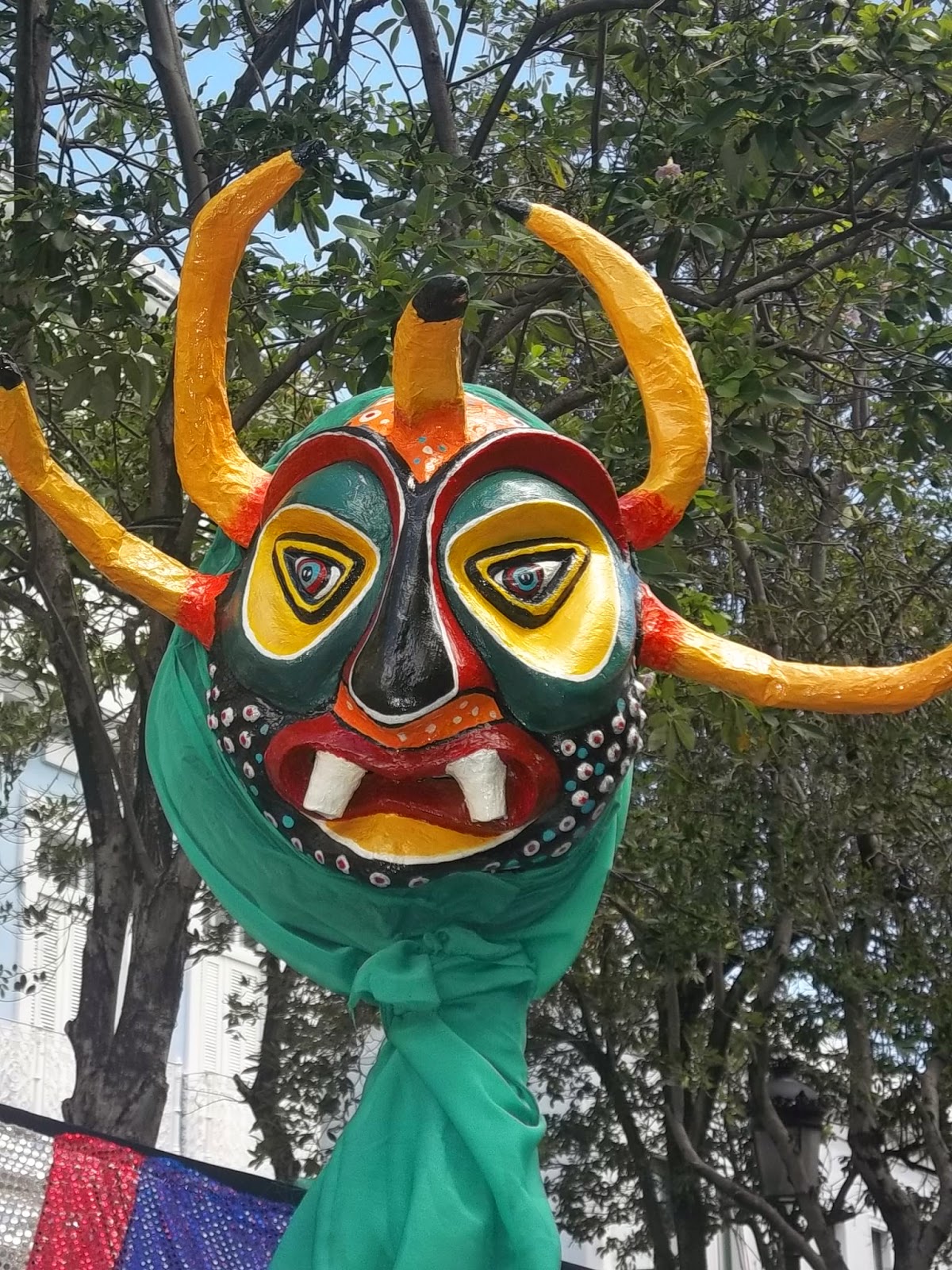
Vejigante in Plaza de Armas
It might be conceit. Or it might be just my American-ness, the true American-ness of all of us who inhabit these two big New World continents and who've inherited all their messy, confused, complex, complicated, colonized, bloody, blending, building, diverse, pure, ancient, new, developing, developed, declining, rising, superficial, and soulful conceits and sincerities.
Back in the day, I used to travel exclusively to Ireland. I used to go there looking for my roots, thinking that was where I belonged, where I wanted to belong. Beyond Ireland, I dreamed of traveling throughout Europe, but I don't even know why--I guess I thought Europe was where you went to get cultured, to lose your American naivete. It never occurred to me for a long time to travel in the Americas. Again, I don't even know why. Eventually I did branch out beyond Ireland to other European places, and to Australia (where I met more Europeans than Australians--indigenous or otherwise), before finally considering traveling to countries closer to my U.S. home: Mexico, Bolivia, now Puerto Rico.
Cafe in Old San Juan featuring open mic poetry nights on Tuesdays. Stopped in here for the open mic and surprised myself by working up the courage to read two of my own poems. Had a great night--wonderful poets, musicians, comics, singers here. My favorite of the night was a young slam poet named Egedeme who performed the two poems I've posted above and below this pic. You should check the place out: https://www.facebook.com/poets.passage
Mural at beach in Carolina, Puerto Rico--The Beaches are for the People
My first full day in Puerto Rico I took a ride out to Piñones, a town on the north coast of the island, about 10 miles east of San Juan. I rented a bike for 4 hours from a vendor in Ocean Park and rode out from there. Along the way, I kept knocking into poles and (almost) the occasional pigeon and person (the bike was a little top-heavy and hard to control) and stopped at every third person I passed to make sure I was still on the right path. Even so, I managed to get a little lost, turning right at the cockfighting arena instead of keeping left by the Ritz Carlton (right, left, cockfighting ring, Ritz Carlton—what’s the difference, really?). I also stopped to take a picture of a mural that caught my attention—a tall, wide piece filled with characters bearing slogans and topped with the three wise men bearing gifts for a missing Jesus. I stopped simply because I thought the mural especially well-done—in doing so, I ended up learning something about Puerto Rico that all the guidebooks I read beforehand failed to mention, something important, something political, and something with a history dating back nearly 20 years.
Cockfighting arena, Isla Verde, San Juan...donde esta little Jerry Seinfeld?
The mural that stopped me in my tracks is in the parking lot of a beach in the town of Carolina, best known as the home of the Luis Muñoz Marin international airport and birthplace of baseball great Roberto Clemente and the poet Julia de Burgos. Behind the mural is a camp that activists set up 10 years ago, in 2005, to protest a hotel development plan and protect the beach and its ecology for the people of Carolina. The presence of this camp—a decade-long continuous protest—stands as the longest act of civil disobedience in the history of Puerto Rico.
I wouldn’t have known this if a man hadn’t been pulling out of the parking lot as I stopped to take the picture. He called out to me from his truck and told me to go in, gesturing to the thicket of trees behind the mural. I thought maybe there was a restaurant somewhere there in the trees and the man maybe worked there and was trying to drum up business, so I just smiled back at him politely and kept focusing on my picture taking and keeping my clunky bike upright. But the man kept saying “It’s free!” And it became clear he was trying to tell me something important. As a plane from the airport was choosing that moment to fly right over our heads, I only got bits and pieces of what the man said: “It’s free”; “You can go in”; something about Piñones; something about a camp; something about the number ten. The last bit he flashed at me with his hands and fingers. And that was all I caught and understood before he pulled out onto the road and I cycled on ahead to Piñones.
As I cycled on, I tried to piece together what the man had told me. I guessed there must be campgrounds there behind the mural that were open until 10:00 PM. The 10 he flashed at me couldn’t mean a $10 cost to get in or stay there, because he kept telling me “it” was free. It was some place open until 10 in the evening then. That must have been it. Meanwhile, I had to have my bike back at the rental place in Ocean Park by 5:30, so if I didn’t spend too much time at Piñones, I’d try and stop in and look at the campgrounds behind the mural, because I’d nodded to the man that I would and there was something about it that seemed so important to him that intrigued me.
Now, there’s an important detail to consider in the paragraphs above. The plane flying over our heads, the one that blocked out much of what the man was trying to tell me, is a fact of life now to the people in Carolina. A good chunk of what used to be an area of mangroves and sugarcane is now the international airport—and what isn’t airport land has largely been converted into other corporate and industrial property for pharmaceutical and medical equipment companies. Noise pollution has become an everyday bane for people living within proximity to the airport (something I know about myself, having grown up close to Chicago’s O’Hare Airport, the world’s busiest). And because of corporate development, little of the natural habitat of Carolina is left except what clings to the shoreline in between Isla Verde and Piñones.
A word about Isla Verde and Piñones—despite their closeness to each other, there’s a marked contrast between the two communities, especially along the shoreline. Isla Verde, which is technically part of San Juan, is a community of expensive high-rise hotels and casinos (such as the aforementioned Ritz Carlton) that sit right on the beach—which means good portions of the beach are off-limits to non-residents and non-patrons of the hotels and condos. You gotta pay to play on the playas here. Piñones, a neighborhood of the municipality of Loíza Aldea, is poor in commercial development and tourism but rich in natural beauty and Afro-Caribbean culture. Parts of the beach at Piñones are clustered with food shacks and rustic beach bars that sell coco fríos (chilled coconuts with a straw stuck in them for drinking the milk right out of the fruit) for 2 bucks each and classic Puerto Rican specialties like mofongo and fish fritters. The smell of roasting chicken, shrimp and pork, smoke rising from the multitude of outdoor grills, and salsa, reggaetón and bomba music are everywhere at the entrance to this community, but if you walk or cycle on further, there’s a boardwalk leading to a state forest and beach, el Bosque Estatal de Piñones, with a nature trail and several wild, secluded beaches. It costs nothing to enter the state forest or sit on the beaches—all of Piñones is free and welcoming to locals and tourists alike.
Ocean Park playa, looking east towards high-rises of Isla Verde
Carolina playa (the playa under dispute), looking west towards Isla Verde hotels
Piñones
Pinchos in Piñones
Coco frio
Fishing at Piñones
Whatever happened to Miami Vice? ;-) Abandoned food shack/bar at Piñones
At Piñones
Playa at Piñones
In between the beaches of these two communities is Carolina’s beach, one that gets much less attention from tourists and guidebooks to Puerto Rico but one that has the same beautiful sands and ecological treasures just as the others do. What Carolina’s beach, or playa, also has is the potential to end up very much like highly developed Isla Verde beach or protected Piñones. It all depends on who wins a dispute over the future of the playa going back 20 years: a group of locals and environmental activists that calls itself the Coalición Playas Pa’l Pueblo or a major, multi-property hotel and resort developer named Eduardo Ferrer Bolívar.
The origins of the dispute are in a contract signed in 1996 by then-governor of Puerto Rico Pedro Rosselló González that leased five acres of the Carolina coast to Desarrollo Hotelero Carolina, Inc., a company whose rights were bought up for $6 million by Ferrer Bolívar. The contract granted Ferrer Bolívar—who already owns a hotel complex right by the Carolina playa, mainly the Courtyard Marriott Isla Verde Beach Resort—a 99-year lease on the property. Locals in the area guessed Ferrer Bolívar would turn these five acres into another Marriott complex, complete with a hotel, spa, and parking lot. Such a development would make the playa off-limits to the people of Carolina and block them from their own coastline. Environmentalists also objected to any development, citing the presence of leatherback sea turtle (a critically endangered species) nests in the area.
Skip ahead to 2005, when those who had been objecting to any more development along the coast claim Ferrer Bolívar’s enterprise had begun moving dirt and sand and cutting away plant growth, despite still not having full approval to do so. One factor was the lack of an environmental impact study when the contract was originally signed or any time since then. A number of activists responded to these beginnings of development by setting up a camp on the playa. Ten years later, that camp is still there.
The camp is located off the road, behind the mural in the parking lot, in a thicket of trees. It’s a true camp, with tents, a porta-potty, and outdoor grills. It also hosts a family of cats and dogs, who laze and take shade among the coastal growth that lines the paths through the camp leading to the beach and sea. For something that’s been around for 10 years, it doesn’t look too shabby. The camp and the energy and resistance behind it exist on paper as well as on the playa. As of only a few weeks ago, the Coalición Playas Pa’l Pueblo has collected 8,500 signatures objecting to corporate, resort, and hotel development on the contested five acres and supporting the creation of a protected status for the coastline—a Bosque Costero de Carolina. (The coalition also has online petitions that you can sign and a Facebook page where you can find out the latest news and show your support.)
Part of the camp at beach in Carolina
Carolina beach kitty
View of the sea and sand from camp at Carolina beach, some of the natural habitat visible too
With 20 years having gone by and no proposed hotel complex in sight, it may seem like the people of Carolina can breathe easy. But in December 2012, Ferrer Bolívar sued the municipality of Carolina and the camp coalition for $5 million in compensation and removal of the camp. I have not been able to find whether this suit has been resolved--if anyone who reads this knows of any updates regarding this lawsuit, I'd appreciate it if you leave a comment below. The fact that the coalition to protect the playa is still collecting signatures and still demanding a definitive act of support from the governor says everything about how vulnerable the playa still is to development.
Now, since I’m not Puerto Rican and am only here for a few days as a tourist, readers might ask why I decided to blog about this issue. For one, because it’s interesting and important. It was certainly important to the man I met while photographing the mural. He didn’t have to tell me anything about what I was photographing. He could have just written me off as a vapid tourist, only interested in Puerto Rico for the sunshine and rum drinks or as a playground for spoiled Americans. But he trusted me with an issue affecting his home, and by going back to visit the camp, finding out what it was all about, and writing this post, I’m trying to honor this local man’s trust in a tourist and foreigner.
Also, as someone who’s been traveling quite a bit in recent years, I’ve learned that reckless tourism and over-development (and the ensuing local cultural and environmental destruction) are huge problems all the world over. I think it’s up to travelers to try and remedy that, to do what they can to travel with a sense of ethics and sensitivity to local and regional cultures and landscapes. And I think it’s up to tourists to make it clear that part of the reason they like to visit other places is for the chance to experience local authenticity and pristine landscapes. It may surprise some developers and tourism promoters that not all travelers are seeking solely luxury and convenience. And even those travelers who do like luxury and convenience probably agree that whole regions and countries shouldn’t be transformed, carved up, and handed over to developers just for their sake.
And it seems like in this case, of the public beach in Carolina, that’s what’s at stake here. Most of Carolina has already been physically transformed for the sake of corporate and economic development —but at least the people there still had their local beach to go to, their piece of the beautiful sea, the palm trees, the sun and sand, and the kind of unique local identity that springs from living along a Caribbean coastline for generations. A hotel and spa complex—yet another of many hotels and resorts right down the road from Carolina—will literally get in the way of what the people of the area have rightfully had and known for generations.
Playa of Carolina, with natural habitat visible on left, Isla Verde hotels on right in background
And does this area really need another hotel resort and spa? The pictures I’ve shared in this post show just how many there already are on the beaches in the area. What could another massive development on the beach possibly boast that all the other ones don’t already have? My bike ride from Ocean Park to Piñones was all I personally needed to convince me that another big hotel is hardly what’s needed around here. Though I was told my ride would “follow the coastline” or “follow the beach walk,” half the time I had no view whatsoever of the water…because of all the tall buildings in the way. Instead I rode past miles of neighborhoods, high-rise hotels and resorts, fast food joints, bars, hell even a cockfighting arena. And one wrong turn and I could have ended up on the tarmac at the airport. But I kept on because of what I was promised at the end—a laid-back little community and a forested, public beach called Piñones.
Hopefully the governor of Puerto Rico and all the Puerto Rican powers-that-be will soon recognize what treasure they already have in the playa of Carolina. The treasure is already there—it doesn’t need any developing or perfecting. Just protecting. But don’t take my word for it—take the word of the people of Carolina. The people have spoken, and the people should be heard and respected. The playas are for the people. Las playas son del pueblo.