 |
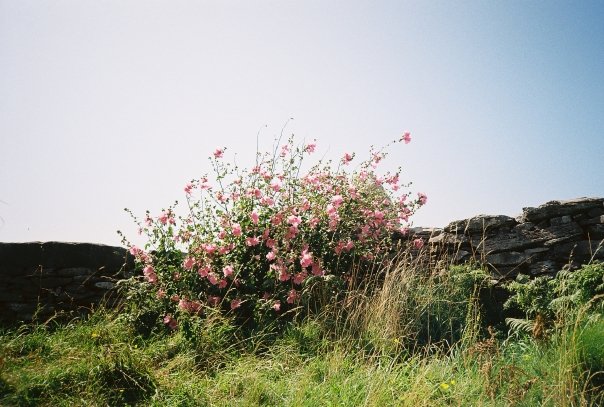
| Flowering bush on Inis Oirr |
Showing posts with label inisheer. Show all posts
Showing posts with label inisheer. Show all posts
Wednesday, July 11, 2012
A Well Written Story
The Aran Islands website posted a new story of mine on their blog yesterday: Walking To The Well. It's another Inis Oirr story--about the holy well on the island, which locals believe has the power to heal. Check it out and share it around if you like.


Sunday, September 18, 2011
Aran Islands Walks
 |
| Inis Oirr, Aran Islands, Ireland |
 |
| One of my usual walking partners. |
Meanwhile I always wondered why Inis Oirr never had someone available who could take a visitor around and tell the true, full story of the island. There were pony and trap tours and wagon tours and even van and car tours of the island, but…Inis Oirr isn’t really that big of a place. It’s a place of all kinds of stone nooks and rock crannies and narrow, half-hidden boreens. A place that better reveals its stories and secrets to those who seek them out at a walker’s pace, a rambler’s tempo rather than any driver’s rush.
I was happy to hear that this year a new tour business was launched on Inis Oirr—a walking tour company called Aran Islands Walks. Finally—someone who can show off the island the way it’s meant to be shown off, on foot.
I was happy to hear that this year a new tour business was launched on Inis Oirr—a walking tour company called Aran Islands Walks. Finally—someone who can show off the island the way it’s meant to be shown off, on foot.
 |
| Eoghan Poil of Aran Islands Walk, in the Inis Oirr cemetery. |
Aran Islands Walks was started up this spring by Eoghan Poil, a native Inis Oirr man who’s only lived off the island during his college years. He lives full-time on Inis Oirr now, serves as a manager for one of the Aran Islands’ football teams, and just married (only a few weeks ago) a woman from neighboring Inis Mor. “I didn’t go far,” he says and smiles, when I ask about his new bride, who has also partnered with him in getting Aran Islands Walks off the ground this summer. So far they seem to be off a good start, with a website and Facebook and Twitter accounts already set up and strong support from other island businesses. Indeed when I ask another recent Inis Oirr entrepreneur, Brid Ni Chualain, who’s recently begun teaching summer adult Irish-language courses, about Eoghan’s new business, she confirms that a number of her students this summer took tours with Aran Islands Walks and reported the walk as a highlight of their week on the
island.
A week ago while visiting the island, I met up with Eoghan and took a walking tour with him. There are many positive things I can say about Eoghan’s tours, and the best is that even after working on and visiting Inis Oirr over a span of 15 years, I still learned so much about the island that I never knew before.
island.
A week ago while visiting the island, I met up with Eoghan and took a walking tour with him. There are many positive things I can say about Eoghan’s tours, and the best is that even after working on and visiting Inis Oirr over a span of 15 years, I still learned so much about the island that I never knew before.
 |
| The Plassey, a ship wrecked on the island in 1960 |
 |
| Grave of the island's patron saint, St. Caomhan. |
 |
| English signal tower (foreground) and the first school on the island (background). |
 |
| Interior room of O'Brien's Castle on Inis Oirr |
 |
| Little stone face on exterior of castle wall |
Aran Islands Walks offers three levels of walks based upon how much time visitors have and their walking ability: a 1 ¼ hour walk, a 1 ¾ walk, and a 2 ½ hour walk, the last of which takes in 14 historical/archaeological sites. The 14 sites include the island’s cemetery and patron saint’s church, which has sunken below the earth (or as Eoghan corrects me, was actually built on level sandy ground that blew up over time and buried the church), a shipwreck ruin that “landed” on Inis Oirr in 1960, a castle, an English signal tower, the island’s first school (a building I’d passed probably 100 times but never noticed—maybe for good reason, as Eoghan told me the island’s landlords only agreed to its establishment if it were built in an inconvenient location, thereby discouraging islander education), and a 10th-century church dedicated to St. Gobnait. Along the way you’ll also learn about the islanders’ field and stonework.
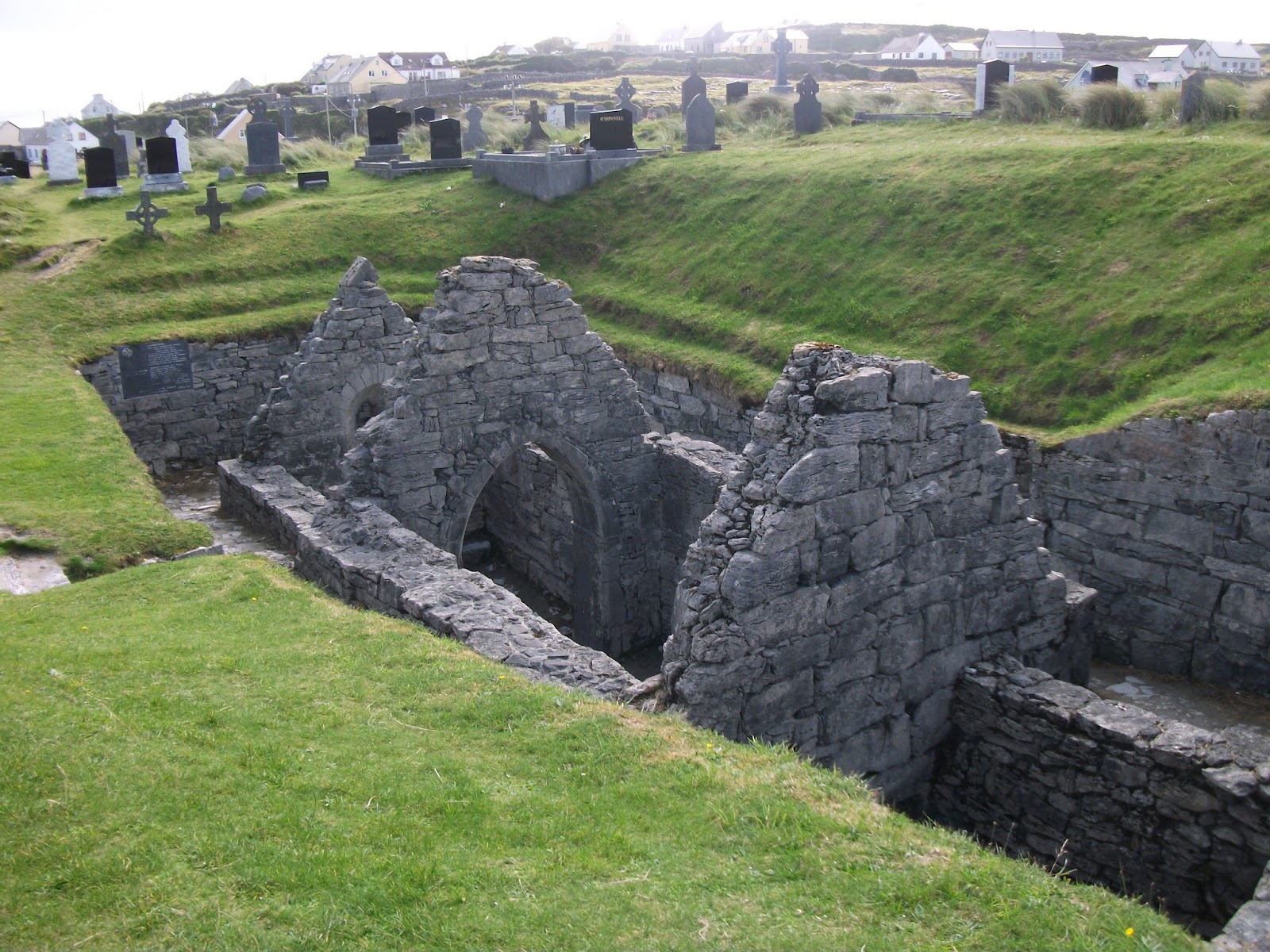 |
| St. Caomhan's church in the island cemetery |
 |
| O'Brien's Castle |
 |
| Eoghan at the Plassey |
 |
| Find out how a field like this... |
 |
| ...Gets cleared to look like this. |
 |
| Side by side view of the two field extremes on Arainn |
And this isn’t even including the “extras”—like the views of the Cliffs of Moher in Clare or the Twelve Pins in Connemara that you can see on a fine day from Inis Oirr, the walk from the pier past the island’s beautiful beach, the exercise in the fresh island air. And since I’m a women’s tour operator and take especial interest in women’s history, Eoghan made sure to tailor the tour to my interests, including the history of Cill na Seacht nInion, the Church of the Seven Daughters, a ruins in a hard-to-find field near the back of the island.
 |
| View of the island lake, the Plassey, and Cliffs of Moher beyond. |
 |
| Eoghan at Cill Gobnait, dedicated to a female saint. |
 |
| Remains of a clochan (beehive hut) at Cill Gobnait. |
After the tour, I was glad to have met Eoghan and glad to have taken a walk with him. And glad he’s started Aran Islands Walks. Inis Oirr is a fascinating place—it’s captivated me for 16 years, if that’s any proof of its hold on the traveler’s soul and senses. A thorough, professional walking tour of the island for visitors was long overdue. Now it’s here for anyone up for a good stroll.
 |
| After the tour with Eoghan I return to my old walking partner, to share all my news about the island. He was so curious to hear it all. |
Thursday, September 15, 2011
Hurricane Katia Comes To Inis Oirr
This past weekend I visited Inis Oirr, the smallest of the Aran Islands. I happened to pick the weekend that Hurricane Katia landed on the tiny island's shores and ended up stranded for an extra night on the island, with all boats canceled for a day or two. Strong winds be damned, I walked about the island snapping some pictures of what the storm did to the island's landscape. Here are some of the shots.
 |
| Inis Oirr beach before the storm hit. |
 |
| Same beach after the storm. |
 |
| Seaweed-covered strand. |
 |
| More seaweed than sand! |
 |
| Seabird and seaweed. |
 |
| Waves rolling in from Inis Meain. |
 |
| The calm lake, the wrecked Plassey, the storm waves, and shadowy Cliffs of Moher. |
 |
| Storm clouds haunting the Plassey. |
 |
| Dog and foam. |
 |
| Inis Oirr lighthouse looking out at the storm waves. |
 |
| Shore. |
 |
| Stones and storm waves. |
 |
| Rolling in. |
 |
| Crash. |
 |
| Hurricanes can make everything go topsy-turvy for awhile. ;) |
 |
| Inis Oirr pier, covered in seaweed tossed up by the storm. |
 |
| Inis Oirr pier, closed. |
 |
| Clouds, cemetery cross, and children crossing. |
 |
| Cross and storm clouds. |
 |
| Me on the beach. |
 |
| On the boat leaving Inis Oirr, first day going out again. |
 |
| On the ferry. |
 |
| Waves chasing the ferry. |
 |
| Leaving. |
 |
| Drenched ferry windows. |
Thursday, March 31, 2011
My Life On The Littlest Aran Island, Part 2
Continued from Part 1
As I write this it’s the end of March, the close of winter, and things are still quiet on Inis Oirr. But a month from now, Easter weekend, the tourist season will officially begin. The hotel with the funny name will open up and begin taking bookings, and the number of sailings ferrying tourists from the mainland and between the islands will see a big jump. As one islander who works on the boats says, “Another few weeks and we won’t have time to blink.”
Time is a funny thing on Inis Oirr. For a visitor, even just a weekender, one of the first observations about the island is its timelessness. “Ever notice how slow the time goes out here?” Everyone has to ask that question, out loud, at some point while being on Inis Oirr. It’s the island law. (Anyone failing to ask that question while on Inis Oirr is immediately banished to a weekend on the middle island, Inis Meain, where the time goes even slower.) But it’s true. Island life is forever curing people of timekeeping.
Example. Go for a drink in the pub. Order and have a look at your watch. Five minutes to 2:00. OK. Get your drink, take a few sips, have a chat, scratch your chin, readjust your sitting, take another look at your watch. One minute past 2. What? You’d swear a half hour had just passed, at least 15 minutes. After a day or two of this kind of time trickery, it’s enough to make you toss your watch into the sea. No need for it after all, no need to keep tracking time as if the hours were unreliable pets. This is a place where time can take care of itself. The island farmers work hard to make their fields yield crops, and the surrounding sea is filled with fish, but it always seemed to me that Inis Oirr’s great harvest is time.
What to do with all this time? Compared to even tiny mainland towns, there’s little in the way of diversion on Inis Oirr. Here’s the rundown. There are 3 pubs: the hotel pub, Tigh Ruairi (on a hill just above the hotel), and Tigh Ned (down past the pier). There’s food available in all of them, and there’s another restaurant beyond Tigh Ned that’s open from time to time. There’s also a lovely little café next to Tigh Ruairi. For shopping, there’s a little general store connected to Tigh Ruairi and there’s also a thatched house turned gift shop that sells jumpers and island crafts. In recent years, an arts center has opened on the island that offers art events, courses, films, plays, all kinds of activities. But it wasn’t there back in the 90s. So for cinematic entertainment we had to settle with the selection of 6 or so videos that an island family rented out from their home. The family had an arrangement with a video shop in Galway and would take the boat to the mainland once a week or so to swap one batch of videos for another one. I remember stopping into their home, er, shop a couple times to find their modest video collection neatly laid out on a table covered with a nice tablecloth. I remember worrying about stopping in for a video “one of these days” and interrupting the family at dinner.
There was also a tiny library that loaned out Irish-language books. There was said to be a handball court somewhere, but I never visited it so I have to take that on hearsay. There’s a football pitch and an island football club, and back in the 90s there was a kids boxing club. Finally there’s a small campsite, a bike rental (that also used to have a little café run by the same family), and the beach. On a fine day you could never underestimate the pull of that lovely beach, with the slip at one end that runs down into turquoise-colored water and the great rocks at the other end that are perfect for jumping off of when the tide is high or hiding amongst and sunbathing on when the beach itself is very crowded.
It takes real effort finding some way to pass the time day in and day out on Inis Oirr. This was true for me even while working two 4-hour shifts a day (lunch and dinner or breakfast and dinner), 5 days a week at the hotel. Cooking soups and starters (salads and appetizers), washing dishes, scrubbing spuds (loads and loads of spuds, big pots of them, every day, grown in the sand on the island and coming to us in sacks with all the soil still stuck on them), chopping vegetables, taking orders, cleaning rooms and making beds, cleaning the kitchen--those were my responsibilities. But these were solely work responsibilities. Beyond them I had few others, being just a “blow-in” on the island. So my sense of the timelessness of island life is probably very different from the islanders themselves, who would find their time taken up with many more responsibilities, between raising families, taking care of their homes and fields, going to school, and working all the various jobs there are on the island.
The first time I returned to the U.S. after working on Inis Oirr and tried describing the island to some Americans, many people wrongly assumed it to be a place that existed only for tourism, with solely a tourist economy. “So it’s like Mackinac Island,” I remember a neighbor saying, referring to an island resort in Michigan in Lake Huron famous for its extensive (to understate it) selection of fudge shops and trinket stores. But Inis Oirr is anything but a tourist trap. The islanders live here year-round, and the families here have been here for generations and generations. This is not their retirement community or summer colony. The kids get all their schooling here through their teenage years (though up until a few years ago, island children had to leave the island and go to boarding schools on the mainland for their secondary schooling), and the islanders maintain and work in their own small airport, post office and bank, nursing station, and co-op. There isn’t a fudge shop in sight.
In the meantime, as in any other community, the year on Inis Oirr is punctuated with dates and events that are important to the local community. I am admittedly more familiar with those in the summertime. One of the most important days in the island’s summer calendar is June 14th, the feast day of Inis Oirr’s patron saint, St. Caomhan. Caomhan lived in the 5th century and was the brother of a more famous saint, St. Kevin, the man who founded the monastic settlement of Glendalough in County Wicklow. On Caomhan’s feast day, the activities on Inis Oirr revolve around an old stone church that lies sunken in a sand dune that also serves as the island graveyard. The church was built on the dune and devoted to Caomhan many centuries ago. Year in and year out, as the church began sinking deeper into the sand, the islanders would dig out the church in preparation for the feast day. Though as pictures show, this became something of a losing battle. Eventually, grass was planted around the church to keep it from sinking any deeper.
Apart from its sunken-ness and missing roof, the church is still in rather good shape. At least, you can still see the carving in stone on the old altar, which has held up remarkably well given the number of people who have stepped on it. Literally. For there’s a superstition on the island that if you can fit through the tiny window behind the altar to climb onto the altar itself, it means you’re going to heaven. There’s a trick to it.
Some summers saw a ceili on St. John’s Eve. A ceili is a dance and music event. Sometimes a live band is featured, other times just records of traditional Irish music. The dances are usually waltzes and jives and traditional dances with battle names like The Siege of Ennis or The Walls of Limerick, similar to the line dances or contra dances in America. Sometimes there are set dances too (something like American square dances). And occasionally an old sean-nos dancer steps out on onto the floor and shows his stuff, though I actually saw more of that type of dance in the island pubs than at the ceilis. On Inis Oirr the ceilis are held in a hall by the football pitch. There are more often ceilis for the teenagers in the early part of the evening, especially for the scolairi, the kids and teachers who come to the island for a few weeks every summer to learn and practice their Irish. The adult ceilis (ceili mor) are less frequent, and usually don’t begin until the pubs finally close and let everyone out, which on Inis Oirr could mean anytime from1 to past 3 in the morning. My first ceili was a bit of a bust, with only about 10 or 15 islanders out for it. Later came better and bigger ones, with the hall crammed with line after line of dancers swinging and stomping their way through a mighty Siege of Ennis.
I mentioned the pubs. In the 90s Inis Oirr became a bit notorious as “the island where the pubs never close.” This was after a guard (policeman) came to the island one summer’s bank holiday weekend dressed undercover as a backpacker. After stopping in all 3 of the pubs after midnight in his backpacker costume, he changed into his guard uniform and came back to raid each of the pubs. A dirty trick. The story made the news and papers throughout Ireland, and for awhile I’d say Inis Oirr attracted a stream of careless partiers wanting to turn the tiny island into their playground, as if they were back in the Temple Bar district in Dublin and not among the homes and family businesses of a genuine community.
In reality, of course the island pubs close down every night--just when they want to is all. And even at the height of the tourist season you can just as well come out to a pub of only half a dozen islanders sitting very quietly around their pints as you can a pub packed out with people. Sometimes I think I enjoyed the quiet nights better than the crowded ones. My first night on the island I was invited out to the hotel pub with my new co-workers and sat with them listening to a small crowd of islanders taking turns singing Irish songs, sean-nos style. As each singer took his or her turn, whoever was sitting on either side of the singer would take their hands and wind them forward, to give the singer encouragement. The music that night was a send-off for one of the island boys, named Mairtin, who was leaving the island to work on an American ship. Mairtin comes from a musical family, a family of strong-voiced singers and good banjo and box-players. They were all out in fine form that night. I left the pub and went to bed early that night (before midnight, early by island standards), and I remember I could still hear the voices of Mairtin’s sister and brother, Maire and Peadar, as I slowly walked down the road and past the beach toward the house--their singing voices were that strong and clear.
One of the last events of the summer is the sports weekend in August. It’s a fun couple of days of everything from currach races to potato sack races, from “toss the wellie” (a Wellington boot) to tug-of-war. The currach races and the football game are the most important and anticipated events of the weekend, with teams from Inis Oirr and the other two islands competing. The prizes for winners are no small trinkets, but actual trophies. The winner of the currach races gets a big cup, big enough to pour whiskey into and pass around the pub as part of the celebration on the eve after the big win.
After the sports weekend, things often go suddenly quiet on the island. It seems to happen so quickly--with the snap of the fingers or the blink of an eye. For awhile the pubs and island roads are swarming with visitors--and then just like that, they’re all gone. One day you see the beach covered in towels with all sorts laying about or wading and splashing in the sea. The next day all you see is a few overturned black currachs and nothing coming down the strand but the first blast of autumn wind. Then before you know it, it’s September, when the hotel with the funny name closes up for the winter and when I had to say my goodbyes to beautiful Inis Oirr...in a manner of speaking that is. Since I've never managed to say goodbye to Inis Oirr completely, not in my heart.
 |
| Sunset on Inis Oirr. |
 |
| Inis Oirr from above. |
Time is a funny thing on Inis Oirr. For a visitor, even just a weekender, one of the first observations about the island is its timelessness. “Ever notice how slow the time goes out here?” Everyone has to ask that question, out loud, at some point while being on Inis Oirr. It’s the island law. (Anyone failing to ask that question while on Inis Oirr is immediately banished to a weekend on the middle island, Inis Meain, where the time goes even slower.) But it’s true. Island life is forever curing people of timekeeping.
 |
| Creatures of Inis Oirr. Donkeys hanging out. |
 |
| Cow in a stony field. |
 |
| Horse at the wall. |
 |
| Goat watching the sun set. |
 |
| Peadar Mhaici and Tom John Kevin taking it easy. |
 |
| This dog's job is to guard the hotel and make sure no one's overworking themselves. |
 |
| Looking for something to do? How 'bout a walk out to the Plassey? |
 |
| Or to Cill na Seacht nInion, an old church ruins in a hard-to-find field. |
 |
| Boxing match on the island. |
The first time I returned to the U.S. after working on Inis Oirr and tried describing the island to some Americans, many people wrongly assumed it to be a place that existed only for tourism, with solely a tourist economy. “So it’s like Mackinac Island,” I remember a neighbor saying, referring to an island resort in Michigan in Lake Huron famous for its extensive (to understate it) selection of fudge shops and trinket stores. But Inis Oirr is anything but a tourist trap. The islanders live here year-round, and the families here have been here for generations and generations. This is not their retirement community or summer colony. The kids get all their schooling here through their teenage years (though up until a few years ago, island children had to leave the island and go to boarding schools on the mainland for their secondary schooling), and the islanders maintain and work in their own small airport, post office and bank, nursing station, and co-op. There isn’t a fudge shop in sight.
In the meantime, as in any other community, the year on Inis Oirr is punctuated with dates and events that are important to the local community. I am admittedly more familiar with those in the summertime. One of the most important days in the island’s summer calendar is June 14th, the feast day of Inis Oirr’s patron saint, St. Caomhan. Caomhan lived in the 5th century and was the brother of a more famous saint, St. Kevin, the man who founded the monastic settlement of Glendalough in County Wicklow. On Caomhan’s feast day, the activities on Inis Oirr revolve around an old stone church that lies sunken in a sand dune that also serves as the island graveyard. The church was built on the dune and devoted to Caomhan many centuries ago. Year in and year out, as the church began sinking deeper into the sand, the islanders would dig out the church in preparation for the feast day. Though as pictures show, this became something of a losing battle. Eventually, grass was planted around the church to keep it from sinking any deeper.
 |
| Standing in Inis Oirr graveyard. |
 |
| Teampall Caomhan, sunken into the hill. |
 |
| Carving on altar of Teampall Caomhan. |
 |
| My friend Declan making it into heaven. This pic is his proof should there ever be any question. |
On June 14th, the day usually begins with a procession on foot to the graveyard and the old church, where an outdoor mass is held. The mass is in Irish. My first summer on Inis Oirr it was a beautiful day the morning of June 14th. Everyone sat above on the grass around the graves while the priest, the altar servers, and a number of the youngest schoolchildren performed the mass below in the church. The children had all learned a tune on their tin whistles just for the occasion, and they played the tune during the procession on the way to the church and after the mass leading out of the church. They may have played it during the mass too. Whistling in the graveyard. Another summer, June 14th saw a very rainy day, and the mass was held in the (comparably) new church in one of the villages, the small, bright white chapel that all the masses are held in throughout the year.
 |
| Altar of Teampall Caomhan. |
After the feast of St. Caomhan, the next day in the island summer calendar is the night of June 23, St. John’s Eve, which honors the birth of St. John the Baptist. You may notice the date of this holiday nearly coincides with Midsummer’s Eve. And perhaps the celebration for the two days have become a bit blended. On Inis Oirr (and once upon a time, throughout Ireland), St. John’s Eve is marked with bonfires that are lit beginning at sunset in villages around the island. Some of the bonfires are rather quiet, local affairs, while the ones later in the evening, usually on the beach after the pubs finally close, can get pretty raucous, especially if it’s a fine night with lots of tourists and visitors about.
 |
| Bonfire madness on St. John's Eve. |
 |
| Morning after the shortest night (and longest bonfire) of the year. |
 |
| Dancing at the ceili. |
 |
| Denise and Caomhan bust a move at the ceili. |
 |
| Set dancing in the hotel. |
 |
| In Tigh Ruairi. Ruairi holding the Sam Maguire Cup, when it was touring Galway. |
 |
| Folks at the bar in the hotel pub. |
 |
| Birthday cake for Tigh Ned's 10th anniversary party. |
 |
| Mairtin and Padraig O'Donnell, Daithi, and bodhran guy in the hotel. |
 |
| Mairtin tossing the wellie. |
 |
| Inis Oirr men losing the tug of war. |
 |
| Inis Oirr women winning the tug of war. Of course. |
 |
| Watching the currach races on Inis Meain. |
 |
| Inis Oirr races. |
 |
| Mystery plaque--mystery because when I asked what it was for, the men answered me in Irish. |
 |
| Mikey celebrating Inis Oirr's win for the currach races. |
 |
| Slan go foill Inis Oirr. |
Subscribe to:
Posts (Atom)